
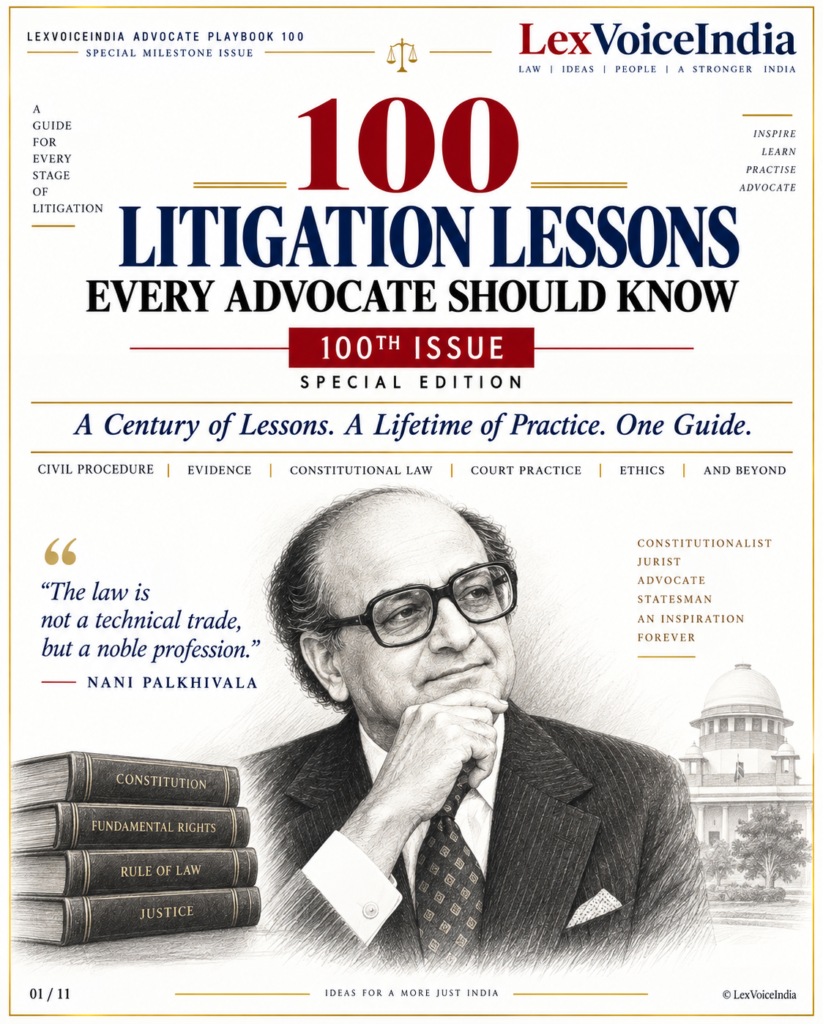
100 Litigation Lessons from the Palkhivala School of Advocacy
How to Think, Prepare, Argue and Practise Like a First-Class Advocate
Nani Palkhivala did not merely argue cases. He elevated the practice of advocacy into an art of clarity, preparation, and intellectual honesty. These 100 lessons distill the essence of that school — not as courtroom tricks, but as a complete way of thinking, preparing, and presenting a case.
Why These Lessons Matter
Most young advocates begin with statutes and citations. The Palkhivala school begins earlier — with the quality of thought itself. Clarity before volume. Preparation before performance. Precision before persuasion.
These 100 lessons are organised to take an advocate from the first reading of the brief to the final executable order, guided by the same discipline that defined one of India’s greatest advocates.
This is an original LexVoiceIndia study of the documented professional methods and advocacy principles associated with N. A. Palkhivala. It is not authored by N. A. Palkhivala, does not reproduce his writings, and does not purport to present these lessons as his personal rules.
Nani Ardeshir Palkhivala belonged to that rare category.
His career cannot be reduced to his celebrated constitutional arguments. He practised in taxation, constitutional law and several other fields, appeared before different courts and tribunals, taught law, wrote extensively and represented India internationally. His professional range was considerable.
But what makes his career especially valuable for today’s advocate is something more practical:
His method.
Accounts of his practice describe a lawyer who did not simply accumulate information. He absorbed it, organised it, reduced it to propositions and then presented the decisive points with extraordinary clarity.
That is the Palkhivala lesson worth carrying into modern practice.
It is the person who can find the right proposition, support it with the right law and facts, and explain it so clearly that the court can work with it.
The following 100 lessons are therefore not attributed to Palkhivala as quotations or as rules he personally wrote. They are an original LexVoiceIndia synthesis of the documented features of his professional method, translated into practical lessons for contemporary advocates.
III. THE JUNIOR ADVOCATE’S ROLE
Lessons 21 – 30
Proposition — Authority — Relevant paragraph — Why applicable.
Analyse it.
“What is the strongest objection to X?”
Answer that too.
IV. RESEARCH LIKE PALKHIVALA
Lessons 31 – 40
Statute → Constitution → Judgment → Rules → Secondary material.
Palkhivala’s major constitutional preparation illustrates the value of extensive background research.
It does not automatically determine Indian law.
V. DRAFT WITH PRECISION
Lessons 41 – 50
Then take it there.
“The order is blatantly arbitrary.”
Explain precisely why the order is legally vulnerable.
Do not turn submissions into a collection of quotations.
“Therefore, what follows?”
VI. COURTROOM ADVOCACY
Lessons 51 – 60
Reason second.
VII. THE ART OF THE PROPOSITION
Lessons 61 – 70
Find yours first.
VIII. CROSS-EXAMINATION THROUGH THE PALKHIVALA LENS
Lessons 71 – 80
IX. CONSTITUTIONAL ADVOCACY
Lessons 81 – 90
Begin with the Constitution.
Where does this power come from?
X. PROFESSIONAL CHARACTER
Lessons 91 – 100
Build it.
Know your file.
Keep your word.
A good advocate remains a student.
Do not merely become more experienced.
Become more precise.
THE PALKHIVALA FORMULA FOR MODERN ADVOCACY
Understand the evidentiary story.
Perhaps the greatest misunderstanding about legendary advocates is that their greatness came from their courtroom performance.
The performance was only the visible part.
Behind it stood:
- years of study,
- command of the subject,
- careful analysis,
- disciplined preparation,
- precise written work,
- mastery of facts,
- selection of authorities,
- intellectual independence,
- and extraordinary concentration.
That is why Palkhivala’s advocacy could appear effortless.
The effort had already happened before he stood up.
Accounts of his working method describe precisely this phenomenon: intense concentration during conferences, rapid absorption of the relevant material, concise written propositions, selective authorities and then highly controlled courtroom advocacy.
That is the lesson worth giving today’s young advocate.
“Speak like Palkhivala.”
But:
“Prepare so deeply that clarity becomes possible.”
LEXVOICEINDIA’S FINAL WORD
Nani Palkhivala’s legacy should not be reduced to a collection of famous quotations.
It is better understood as a standard of professional thinking.
A better lawyer knows which five matter.
A better advocate knows which five propositions the court needs to decide.
A better advocate knows how to make the decisive point in five minutes.
And the finest advocate understands something even more important:
It is a place to help the court decide what the law requires.
That is the Palkhivala school of advocacy as LexVoiceIndia understands it:
Sources & References
This LexVoiceIndia feature has been prepared using primary legal materials, Palkhivala’s published legal propositions, official Supreme Court records and credible biographical accounts concerning his professional life and advocacy method.
-
01Supreme Court of India / E-Courts, Kesavananda Bharati Judgment — The Basic Structure Judgment.
-
02N. A. Palkhivala, “The Fundamental Rights Case: Propositions submitted before the Supreme Court,” (1973) 4 SCC (Jour) 1.
-
03Soli J. Sorabjee, “Celebrating the life and legacy of Nani Palkhivala,” Hindustan Times.
-
04“Nani Palkhivala — The Gentle Colossus,” LiveLaw.
-
05JOTI Journal, June 2025, Madhya Pradesh State Judicial Academy.
-
06Nani Palkhivala Memorial Lectures — Selected Speeches.
-
07“Nani Palkhivala and the Basic Structure,” LiveLaw.
-
08Soli J. Sorabjee & Arvind P. Datar, Nani Palkhivala — The Courtroom Genius.
- Supreme Court Directs Telangana State Bar Council to Provisionally Enrol Law Graduates
- Bona Fide Litigant, Procedural Delay and the Pursuit of Justice: Supreme Court Clarifies the Law
- “Revenue Entry Showing Tenancy is Sufficient – Defendant Need Not Enter Witness Box When Relying on Undisputed Document”
- THE ART OF ADVOCACY
- Bala Krishna Leelas — Glimpses of Divine Childhood
- About Us
- Case Laws
- Civil Law
- Constitutional Law
- Consumer Protection
- Contact
- Contracts & Agreements
- Corporate Law
- Criminal Law
- Employment Law
- Family Law
- Intellectual Property Rights
- Judgments
- Legal Analysis
- Legal Insights
- Legal Insights / Articles
- Legal Insights & Videos
- Legal Research
- Legal Research
- Litigation & Dispute Resolution
- No Expiry Period for Stamp Paper: A Settled Legal Position
- Our Advocates
- Practice Areas
- Property & Real Estate Law
- Web
- Wills, Trusts & Succession
Leave a Reply