
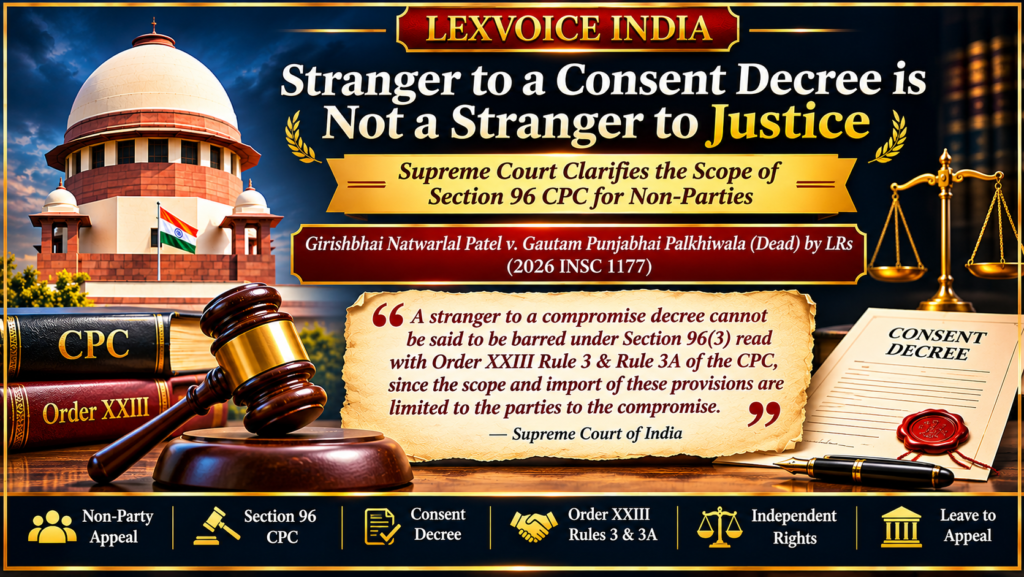
Stranger to a Consent Decree is Not a Stranger to Justice
Supreme Court Clarifies the Scope of Section 96 CPC for Non-Parties
Girishbhai Natwarlal Patel v. Gautam Punjabhai Palkhiwala (Dead) by LRs (2026 INSC 1177)
Introduction
On 30 October 2026, the Supreme Court of India delivered a significant pronouncement clarifying the rights of non-parties (strangers) to challenge a consent decree under Section 96 of the Code of Civil Procedure, 1908. The Court held that the statutory bar against appeals from consent decrees does not automatically extend to persons who were neither parties to the original proceedings nor parties to the compromise, provided they can demonstrate that the decree prejudicially affects their independent legal rights or interests.
The judgment draws a clear distinction between a party who has consented to a compromise and a stranger who asserts an independent right allegedly prejudiced by that compromise. It reaffirms that the principle of estoppel arising from a consent decree operates only between the consenting parties and cannot be mechanically invoked to shut out genuine third-party claims.
Sequence of Facts and Procedural History
- Origin of the Dispute The underlying dispute related to certain land. An agreement to sell dated 11 September 1996 formed the basis of Original Civil Suit No. 322 of 2012. The suit culminated in a consent decree dated 29 April 2013.
- Execution and Subsequent Sale The consent decree was executed. Thereafter, on 18 June 2022, a sale deed was executed in favour of Girishbhai Natwarlal Patel, with a cooperative society joining as a confirming party.
- Challenge by Non-Parties Nine individuals (Respondent Nos. 1 to 9), claiming independent interest in the property through a Hindu Undivided Family (HUF), approached the Gujarat High Court seeking leave to appeal against the 2013 consent decree. They contended that the decree and the subsequent transactions prejudicially affected their rights.
- High Court Orders The Gujarat High Court granted leave to appeal, condoned an approximately eleven-year delay, and continued an ex parte ad interim injunction restraining the appellant from dealing with the disputed land.
- Supreme Court Proceedings Girishbhai Natwarlal Patel challenged the High Court orders before the Supreme Court, contending that a non-party could not maintain an appeal against a consent decree in view of Section 96(3) read with Order XXIII Rules 3 and 3A of the CPC.
Issues Before the Supreme Court
The principal questions that arose for consideration were:
• Whether a person who was not a party to the original suit or to the compromise is barred by Section 96(3) of the CPC from filing an appeal against a consent decree;
• Whether leave to appeal can be granted to such a non-party if the decree prejudicially affects his independent legal rights;
• Whether the High Court was justified in condoning an eleven-year delay and in granting interim protection.
Analysis of the Judgment – Key Holdings
The Court held that Section 96(3) of the CPC, which provides that no appeal shall lie from a decree passed by the Court with the consent of parties, read with Order XXIII Rules 3 and 3A, creates an estoppel only between the parties who actually consented to the compromise.
A stranger to a compromise decree cannot be said to be barred under Section 96(3) read with Order XXIII Rule 3 & Rule 3A of the CPC, 1908, since the scope and import of these provisions are limited to the parties to the compromise and act as an estoppel only with respect to them.
While recognising the right of a non-party to seek leave, the Court clarified that such status does not automatically entitle a person to maintain an appeal. The applicant must prima facie demonstrate a legally cognisable interest that is prejudicially affected by the impugned decree.
Non-party status does not confer an unrestricted right of appeal. Such a person must prima facie demonstrate that the impugned decree prejudicially affects his rights or interests and must obtain leave of the appellate court in accordance with the settled principles governing appeals by persons who were not parties to the original proceedings.
The Court emphasised that the fact that the decree is a consent decree neither relaxes nor tightens the standard for grant of leave. The decisive consideration is whether the applicant has shown a legally cognisable interest that is prejudicially affected.
The Court distinguished the decision in Triloki Nath Singh v. Anirudh Singh, noting that in that case the challenger derived title through a party to the original proceedings, whereas the respondents in the present case were complete strangers asserting independent rights.
Jurisprudential Significance
This judgment performs an important balancing function. On the one hand, it protects the finality of genuine consent decrees and prevents parties who have compromised from resiling from their agreement. On the other hand, it ensures that the finality of a consent decree cannot be used as a weapon to extinguish independent rights of persons who were never before the Court and never consented to the compromise.
The decision reinforces the principle that procedural bars must be construed in a manner that advances substantive justice rather than defeating it. It provides clarity to trial and appellate courts on the circumstances in which leave to appeal may be granted to non-parties challenging consent decrees.
Conclusion
Girishbhai Natwarlal Patel v. Gautam Punjabhai Palkhiwala (2026 INSC 1177) is a carefully calibrated judgment that protects both the sanctity of consent decrees and the rights of genuine third parties. The Supreme Court has made it clear that while a consent decree binds those who consented to it, it cannot be used to silence those who never had a voice in the proceedings.
In doing so, the Court has reaffirmed a fundamental tenet of civil procedure: justice cannot be compromised by the consent of those who were never parties to it.
◆ Full Judgment ◆
Read the complete judgment of the Supreme Court (currently available in full text format):
OPEN FULL JUDGMENTlexvoiceindia.com Home>
Consent Cannot Silence the Unheard: Supreme Court on Non-Party Appeals
Read more: Consent Cannot Silence the Unheard: Supreme Court on Non-Party AppealsLeave a Reply
Leave a Reply