
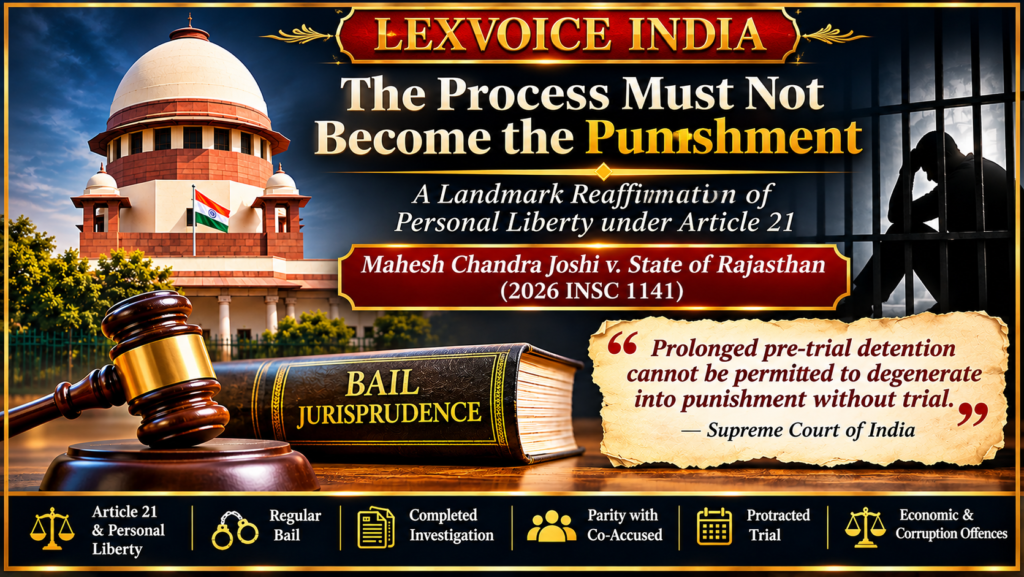
The Process Must Not Become the Punishment
A Landmark Reaffirmation of Personal Liberty under Article 21
Mahesh Chandra Joshi v. State of Rajasthan (2026 INSC 1141)
Introduction
In a constitutional democracy governed by the rule of law, the power of the State to deprive a citizen of personal liberty prior to a conclusive finding of guilt is an exceptional power, not a routine instrument of investigation or prosecution. On 16 October 2026, the Supreme Court of India reaffirmed this foundational principle while granting regular bail to Mahesh Chandra Joshi (a former Minister of the Government of Rajasthan, aged approximately 72 years) and Mukesh Pathak in a case involving alleged large-scale irregularities in tenders floated under the Jal Jeevan Mission.
The Court held, in clear and emphatic terms, that prolonged pre-trial detention cannot be permitted to degenerate into punishment without trial in derogation of an undertrial’s fundamental rights to personal liberty and speedy trial guaranteed under Article 21 of the Constitution of India. The decision is significant not merely for the individual relief granted, but for the calibrated balance it strikes between the gravity of economic and corruption offences on the one hand, and the constitutional protection of liberty on the other.
Sequence of Facts and Procedural History
- Origin of the Investigation A Preliminary Enquiry (No. 06/2024) was registered on 18 January 2024 by the Anti-Corruption Bureau, Jaipur, into alleged irregularities in tenders floated by the Public Health Engineering Department (PHED), Government of Rajasthan, under the Jal Jeevan Mission.
- Registration of the FIR The enquiry culminated in the registration of FIR No. 245/2024 on 30 October 2024 at Police Station Anti-Corruption Bureau, Jaipur. The FIR invoked: Sections 7(c), 9, 10, 12, 13(1)(a) read with Section 13(2) of the Prevention of Corruption Act, 1988 (as amended in 2018); and Sections 409, 466, 467, 468, 471, 477A and 120B of the Indian Penal Code, 1860.
- Core Allegations of the Prosecution The prosecution alleges that between 2021 and 2023, two proprietorship concerns — M/s Shri Ganpati Tubewell Company (owned by co-accused Mahesh Mittal) and M/s Shree Shyam Tubewell Company (owned by co-accused Padam Chand Jain) — acting in concert with public servants in the PHED and private individuals, participated in 237 tenders. They allegedly used forged and fabricated work-completion certificates and letters of acceptance purportedly issued by IRCON International Limited. On the strength of these fabricated credentials, the two firms emerged as the lowest (L-1) bidders and secured work orders in 104 tenders aggregating to ₹979.45 crore (31 tenders valued at ₹859.2 crore and 73 tenders valued at ₹120.25 crore).
- Arrests and Custody Mukesh Pathak was taken into custody on 18 February 2026. Mahesh Chandra Joshi was taken into custody on 7 May 2026 in connection with the present FIR. Prior to this, Joshi had remained in custody for over seven months in a connected proceeding under the Prevention of Money Laundering Act, 2002 (arising from the same factual substratum), before being enlarged on regular bail by the Supreme Court on 3 December 2025 subject to stringent conditions. Nothing on record suggested any misuse of liberty during the interregnum.
- Completion of Investigation and Filing of Chargesheets Investigation against both appellants stood completed: Chargesheet No. 80/2026 was filed on 12 April 2026 against Mukesh Pathak. Supplementary Chargesheet No. 80-B/2026 was filed on 29 June 2026 against Mahesh Chandra Joshi. The prosecution case rests overwhelmingly on documentary and electronic records already seized and in the custody of the investigating agency (tender files, minutes of Bid Evaluation and Finance Committees, official note-sheets, correspondence with IRCON, bank statements, forensic reports of mobile devices, call detail records, and transcripts of intercepted conversations). No further custodial interrogation or recovery was required from either appellant.
- Parallel Proceedings and Parity Both appellants had already been enlarged on bail in connected prosecutions arising from the identical factual matrix (CBI case concerning fabrication of the same IRCON certificates and the related PMLA proceedings). Several co-accused in the present FIR had also been granted bail or interim protection by the High Court and the Supreme Court.
- High Court Order By a common judgment and order dated 13 August 2026, the High Court of Rajasthan (Jaipur Bench) rejected the applications for regular bail filed by both appellants.
- Supreme Court Proceedings Special Leave Petitions were filed. Leave was granted. The appeals were heard and disposed of by a common order dated 16 October 2026.
Issues Before the Supreme Court
The appeals were confined strictly to the question of grant of regular bail. The Court expressly declined to embark upon a roving inquiry into the merits of the prosecution case or to adjudicate contentions relating to:
• maintainability of successive FIRs;
• the plea of double jeopardy;
• alleged infraction of Section 17A of the Prevention of Corruption Act, 1988; or
• legality of the arrest of Mahesh Chandra Joshi.
All such contentions were left open to be agitated before the appropriate forum in accordance with law.
Analysis of the Judgment – Key Holdings and Reasoning
The Court acknowledged that allegations of large-scale financial impropriety and institutional collusion in the execution of a public welfare project such as the Jal Jeevan Mission are grave and warrant serious scrutiny. The State was therefore justified in opposing the grant of bail.
However, the Court held with clarity:
The gravity of the allegations, however serious, cannot by itself eclipse all other considerations governing the grant of bail or justify indefinite pre-trial detention.
Investigation qua both appellants having been completed and the edifice of the prosecution case resting on documentary and electronic material already seized, the Court found that no further custodial interrogation was necessary. The apprehension of tampering with evidence stood substantially obviated.
The fact that both appellants had already been enlarged on bail in connected prosecutions arising from the same factual substratum, without any allegation of misuse of liberty, weighed heavily in favour of grant of bail.
The Court took note of the undeniable volume of the record: 22 accused persons, three chargesheets, 124 cited prosecution witnesses, and 192 documents spread over approximately 20,000 pages. Charges had not yet been framed. Investigation against certain co-accused was still pending, and several co-accused against whom arrest warrants had been issued remained absconding.
Having regard to these factors, the Court observed that the trial, as and when it commences, is likely to take considerable time to conclude.
The Court reiterated a principle repeatedly emphasised in its recent jurisprudence:
Prolonged pre-trial detention cannot be permitted to degenerate into punishment without trial in derogation of an undertrial’s Fundamental Right to personal liberty and speedy trial guaranteed under Article 21 of the Constitution.
In the totality of the circumstances, further pre-trial incarceration of the appellants was held to be neither warranted nor necessary. Legitimate apprehensions of the prosecution could be adequately safeguarded by the imposition of appropriate conditions.
Operative Directions and Bail Conditions
The impugned judgment of the High Court, insofar as it related to the two appellants, was set aside. The appellants were directed to be released on bail (unless their custody was required in any other case) upon furnishing bail bonds and sureties to the satisfaction of the trial court, subject to such further conditions as the trial court might impose, in addition to the following:
◆ Conditions of Bail ◆
- The appellants shall surrender their passports (if not already surrendered) to the trial court and shall not leave India without prior permission of the trial court;
- Inasmuch as further investigation is pending against certain other accused persons, the appellants shall appear before the Investigating Officer and cooperate with the investigation as and when called upon to do so;
- The appellants shall not, directly or indirectly, make any inducement, threat or promise to any person acquainted with the facts of the case or tamper with the prosecution evidence in any manner; and
- The appellants shall regularly and punctually appear before the trial court on each date of hearing (unless specifically exempted) and shall cooperate in the expeditious conduct of the proceedings.
Breach of any condition would entitle the trial court to cancel the bail of the defaulting appellant. The Court clarified that its observations were confined solely to the adjudication of the bail applications and shall not be construed as an expression of opinion on the merits of the case.
Jurisprudential Significance and Critical Analysis
The decision in Mahesh Chandra Joshi occupies an important place in the evolving jurisprudence on bail in economic and corruption offences. It reinforces several settled propositions while applying them with precision to the facts:
• Economic offences, though serious, cannot be treated as a homogeneous class warranting a blanket denial of bail.
• Once investigation is complete and the evidence is predominantly documentary, the need for continued custody is significantly diminished.
• Parity with co-accused already enlarged on bail, absence of misuse of liberty, advanced age of the accused, and the realistic prospect of a protracted trial are weighty factors under Article 21.
• Statutory rigour cannot be permitted to result in indefinite pre-trial detention in violation of constitutional guarantees.
The judgment carefully avoids any dilution of the seriousness of allegations concerning public welfare schemes funded by public money. At the same time, it refuses to allow the magnitude of the alleged scam to convert the process itself into punishment. This calibrated approach is consistent with the constitutional ethos that the presumption of innocence and the right to liberty remain operative until a finding of guilt is recorded after a fair trial.
Conclusion
Mahesh Chandra Joshi v. State of Rajasthan (2026 INSC 1141) is a measured and principled reaffirmation of constitutional balance. It underscores that while the State is entitled — and indeed duty-bound — to investigate and prosecute allegations of corruption with seriousness, the Constitution does not authorise the transformation of pre-trial detention into a form of punishment.
Where investigation is complete, evidence is secured, parity exists, and the trial is unlikely to conclude within a reasonable time, the continued incarceration of an undertrial ceases to serve any legitimate purpose and becomes constitutionally impermissible. The Supreme Court has once again drawn a clear line: the process must not become the punishment.
◆ Full Judgment (PDF) ◆
Click the button below to open and view the original Supreme Court order in PDF format.
OPEN JUDGMENT PDFlexvoiceindia.com Home>
Admissibility of Electronic Records Bharatiya Sakshya Adhiniyam Chain of Custody dailyprompt dailyprompt-2879 dailyprompt-2923 Digital Evidence Electronic Evidence Evidentiary Audit Supreme Court Judgments
Read more: A Constitutional Guardrail Against Pre-Trial PunishmentA Constitutional Guardrail Against Pre-Trial Punishment
Leave a Reply