

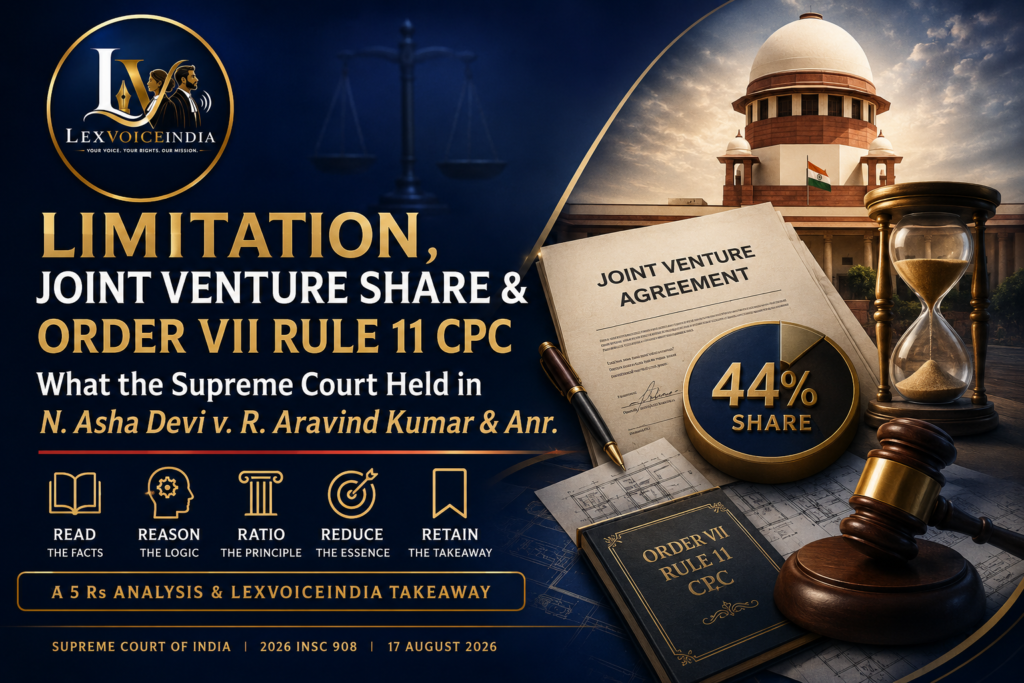
N. Asha Devi v. R. Aravind Kumar & Anr.
Limitation and Rejection of Plaint under Order VII Rule 11 CPC in a Joint Venture Share Claim
5 Rs of Judgment Analysis & LexVoiceIndia Legal Insight
Supreme Court of India
2026 INSC 908 | Non-Reportable
Civil Appeal No. 11194 of 2026
Arising out of SLP (C) No. 23279 of 2025
Decided on: 17 August 2026
Coram: Justice J. B. Pardiwala and Justice K. Vinod Chandran
WHY THIS JUDGMENT MATTERS
Can a suit seeking division and allotment of a 44% share arising from Joint Venture Agreements be rejected at the threshold on the ground of limitation under Order VII Rule 11 CPC, when the plaintiff contends that limitation is a mixed question of fact and law requiring a trial?
The Supreme Court’s answer is yes, where the plaint itself makes the limitation bar apparent.
The judgment also raises a related question concerning the legal character of the claim:
Is a claim seeking division and allotment of a 44% share under a Joint Venture Agreement to be approached in the same manner as an ordinary partition claim between existing co-owners?
That question cannot be answered merely by reference to the words “share” or “division.” The source of the claimed right, the cause of action pleaded, the nature of the relief and the applicable limitation principles require separate examination.
THE CASE AT A GLANCE
The Arrangement
Two Joint Venture Agreements were entered into on 18 August 2014 concerning two vacant plots measuring a total extent of 4,800 sq. ft. Eight flats were to be constructed.
Under the arrangement, after construction:
- 56% of the total super built-up area was to go to the owners; and
- 44%, comprising the undivided share in the land and the super built-up area, was to go to the respondent under the Joint Venture Agreements.
The Dispute
The appellant contended that the construction was not completed within the stipulated period of 15 months and cancelled the Joint Venture Agreements by communication dated 20 April 2016.
The respondent disputed the cancellation and asserted his entitlement under the agreements.
Further notices and correspondence followed during 2016. The Supreme Court also recorded that the appellant took possession of the properties in June 2017.
The Suit
The respondent subsequently instituted O.S. No. 632 of 2022, seeking division and allotment of his 44% share in the land and built-up area as contemplated by the Joint Venture Agreements.
The suit was instituted in October 2022.
The defendant sought rejection of the plaint under Order VII Rule 11 CPC, principally on limitation.
The Trial Court rejected that application and the High Court confirmed the decision.
The matter therefore reached the Supreme Court.
THE 5 Rs OF JUDGMENT ANALYSIS
① READ
What does the judgment actually reveal?
The Supreme Court began from the pleadings.
It relied upon the settled principle that, while considering an application for rejection of a plaint, the averments in the plaint and the documents annexed to it are germane. The Court referred to Shri Mukund Bhavan Trust v. Shrimant Chhatrapati Udayan Raje Pratapsinh Maharaj Bhonsle & Anr., (2024) 15 SCC 675.
The Court therefore did not undertake a full trial into the competing factual assertions.
Instead, it examined what the plaint itself pleaded.
This becomes crucial because paragraph 17 of the plaint expressly identified a series of events as constituting the cause of action, including:
- the Joint Venture Agreements of 18.08.2014;
- the alleged acquisition of the 44% share;
- the cancellation communication dated 20.04.2016;
- subsequent legal notices and replies in 2016; and
- the public notice dated 08.06.2022.
The Supreme Court then asked the decisive question:
When did the cause of action actually arise?
② REASON
Why did the Supreme Court reject the plaint?
The plaintiff argued that limitation was a mixed question of fact and law and therefore should be decided only after evidence was recorded at trial.
The Supreme Court accepted the general proposition that limitation may involve mixed questions of fact and law.
But it emphasised the important qualification:
Where the limitation bar is apparent from the plaint itself, the Court need not hesitate to reject the plaint at the threshold.
Applying that principle, the Court examined paragraph 17 of the plaint.
The Supreme Court concluded that the relevant cause of action arose on 20 April 2016, when the Joint Venture Agreement was first cancelled.
The later communications did not constitute independent causes of action. According to the Court, they merely highlighted the dispute arising from the cancellation.
The Court therefore rejected the argument that the subsequent correspondence could restart limitation.
The plaintiff also relied upon the 08 June 2022 public notice, asserting its 44% interest and cautioning third parties against purchasing the property.
The Supreme Court rejected that contention as well.
The publication was held not to create a fresh cause of action because it was a self-interested publication and itself came after considerable delay.
③ RATIO
What legal principle should be extracted?
RATIO DECIDENDI
Where the plaint itself discloses facts showing that the suit is barred by limitation, the plaint may be rejected under Order VII Rule 11 CPC even though limitation may ordinarily involve a mixed question of fact and law.
A further principle emerges from the Court’s reasoning:
Subsequent correspondence which merely continues or highlights an existing dispute does not, by itself, create a fresh cause of action so as to revive limitation.
⚠️ IMPORTANT LIMITATION ON THE RATIO
This judgment must not be read as laying down that:
“Every partition suit is barred by limitation.”
Nor does it establish that:
“Every limitation issue can be decided under Order VII Rule 11 CPC.”
The Supreme Court’s decision is tied to the plaint before it and to the cause of action disclosed by the plaintiff’s own pleadings.
That distinction is essential.
④ REDUCE
The judgment in one legal frame
2014
Joint Venture Agreements
44% contemplated for the respondent
↓
20.04.2016
Joint Venture Agreements cancelled
↓
2016
Further notices and correspondence
↓
08.06.2022
Public notice asserting 44% entitlement
↓
October 2022
Suit for division and allotment of 44% share
↓
Order VII Rule 11
Limitation objection
↓
Supreme Court
Cause of action treated as arising on 20.04.2016
↓
FINAL RESULT
Plaint rejected.
REDUCED TO ONE SENTENCE
The Supreme Court held that the plaintiff’s own plaint disclosed the cause of action arising from the cancellation of the Joint Venture Agreements in 2016, and that subsequent correspondence and the 2022 public notice did not create a fresh cause of action; consequently, the plaint was liable to rejection on limitation under Order VII Rule 11 CPC.
⑤ RETAIN
What should a lawyer carry forward from this judgment?
1. Identify the source of the right
A claim for a “share” or “division” does not automatically tell us what kind of legal right is being enforced.
Here, the claimed 44% entitlement arose under Joint Venture Agreements.
Therefore, the source of the right must be examined before characterising the claim and analysing limitation.
2. Do not confuse division/allotment with every conventional partition suit
The Supreme Court described the suit as one for division and allotment of 44% share.
But the 44% entitlement was connected to the Joint Venture Agreements.
Therefore, the relief may be partition-like in form without necessarily being identical to a conventional suit for partition by an already recognised co-owner.
3. “Limitation is a mixed question of fact and law” is not an absolute answer
Where the plaint itself makes the limitation bar apparent, Order VII Rule 11 can operate.
4. Subsequent correspondence does not automatically restart limitation
A series of notices and replies concerning the same dispute does not necessarily generate successive causes of action.
5. A later self-generated assertion cannot automatically revive a stale claim
The 2022 public notice did not create a fresh cause of action merely because the plaintiff again asserted the same 44% right.
6. Do not overstate what rejection of the plaint means
The Supreme Court rejected the plaint at the threshold.
It did not conduct a full trial and pronounce upon every aspect of the substantive controversy concerning the 44% entitlement.
7. A fresh proceeding cannot simply change the label
A party cannot ordinarily overcome limitation by changing:
“division” → “partition” → “declaration” → “recovery”
if the underlying cause of action remains the same and is already time-barred.
Any genuinely distinct remedy must independently satisfy the applicable limitation law
LEXVOICEINDIA DEEP-DIVE
The Questions Behind the Judgment
The judgment is principally concerned with rejection of a plaint on the ground of limitation. It also raises questions concerning the legal character of the plaintiff’s 44% share claim, the source of the claimed right, and the effect of subsequent events on the cause of action.
QUESTION 1
Was this a conventional partition suit?
Not in the sense of an ordinary partition suit between existing co-owners.
The suit sought division and allotment of a 44% share in the land and built-up area under the Joint Venture Agreements.
Although the relief involved division of a share, the claimed entitlement arose from the Joint Venture Agreements dated 18.08.2014. The legal character of the claim therefore cannot be determined solely from the words “share” or “division” used in the relief.
The source of the claimed right, the nature of the relief and the cause of action pleaded must be examined together.
QUESTION 2
Why did limitation arise despite the claim for a 44% share?
The Supreme Court examined the cause of action pleaded by the plaintiff, particularly paragraph 17 of the plaint.
The plaint itself referred to the cancellation of the Joint Venture Agreements on 20.04.2016, together with subsequent notices and correspondence, as part of the events giving rise to the dispute.
The Supreme Court treated the cancellation dated 20.04.2016 as the relevant cause-of-action event for the limitation issue before it.
The subsequent notices and correspondence did not constitute fresh causes of action merely because they occurred later. The Court also did not accept the 08.06.2022 public notice as creating a fresh cause of action.
Accordingly, the Court found that the limitation bar was apparent from the plaint itself and that the plaint could be rejected under Order VII Rule 11 CPC.
The important point is therefore not that a claim for a “share” is inherently subject to a particular limitation rule, but that the plaint itself disclosed an earlier cause of action from which the limitation bar was apparent.
QUESTION 3
Could the limitation objection be avoided merely by changing the form of the relief?
Not merely by changing the nomenclature of the claim.
If the underlying cause of action remains the same, describing the relief differently as “division,” “partition,” “declaration” or “recovery” does not, by itself, create a fresh cause of action or overcome an existing limitation bar.
The relevant inquiry is substantive:
What right is being asserted?
What event gave rise to the cause of action?
What relief is actually being sought?
Which limitation provision applies to that relief?
A genuinely distinct cause of action or legally independent remedy would require a separate examination of its own limitation consequences. The present judgment should therefore not be read as deciding every possible remedy arising from the Joint Venture Agreements.
CORE TAKEAWAY
A claim described in terms of “share” or “division” does not, by its terminology alone, determine the applicable limitation analysis. The source of the right, the cause of action pleaded, the nature of the relief and the applicable limitation provision must be examined together.
Pleadings identify the cause of action. Labels alone do not determine it.
SCOPE OF THE JUDGMENT
What the Court Decided — and What It Did Not Decide
What the Court Decided
The plaint was examined on its own averments for the purpose of Order VII Rule 11.
The Court treated 20.04.2016, the date of cancellation of the Joint Venture Agreements, as the relevant cause-of-action date.
Subsequent notices and correspondence did not constitute fresh causes of action.
The 08.06.2022 public notice did not create a fresh cause of action.
The limitation bar was apparent from the plaint.
The plaint in O.S. No. 632 of 2022 was therefore rejected under Order VII Rule 11 CPC.
What the Court Did Not Decide
It did not lay down a general rule governing limitation in all partition or division suits.
It did not decide the limitation period applicable to every Joint Venture Agreement share claim.
It did not hold that every limitation issue can be determined under Order VII Rule 11.
It did not adjudicate the entire substantive dispute concerning the alleged 44% entitlement after trial.
It did not determine every possible remedy arising from the Joint Venture Agreements.
LEXVOICEINDIA CONCLUSION
The Supreme Court held that where the limitation bar is apparent from the plaint, the plaint may be rejected under Order VII Rule 11 CPC. In this case, the Court treated 20.04.2016 as the relevant cause-of-action date and found that subsequent communications did not create a fresh cause of action.
The decision is confined to the pleadings and limitation issue before the Court and should not be extended beyond its ratio.
This LexVoiceIndia Legal Insight presents an independent professional analysis and critical examination of the Supreme Court judgment discussed in this article. It is intended to promote legal understanding, research, discussion and informed appreciation of the principles emerging from the decision.
The 5 Rs of Judgment Analysis — Read, Reason, Ratio, Reduce and Retain — and the LexVoiceIndia Takeaway Analysis are editorial and analytical frameworks developed to examine the judgment, identify its legal reasoning and ratio, clarify its scope and limitations, and highlight its practical significance.
The analysis should be read together with the original judgment, applicable statutory provisions and relevant precedents. The views and observations expressed under the LexVoiceIndia analysis are intended to facilitate legal research and professional discussion and should not be understood as extending the Court’s decision beyond what was actually adjudicated.
LexVoiceIndia seeks to present law with clarity, depth and analytical perspective while preserving the distinction between the Court’s holding and independent editorial analysis.
Leave a Reply
Leave a Reply