
Home Legal News Supreme Court High Courts Legal Research Judgment Analysis Case Law Advocacy Articles More
lexvoiceindia.com Home>
The 5 Rs of Judgment Analysis: A Practical Method for Advocates, Researchers and Law Students
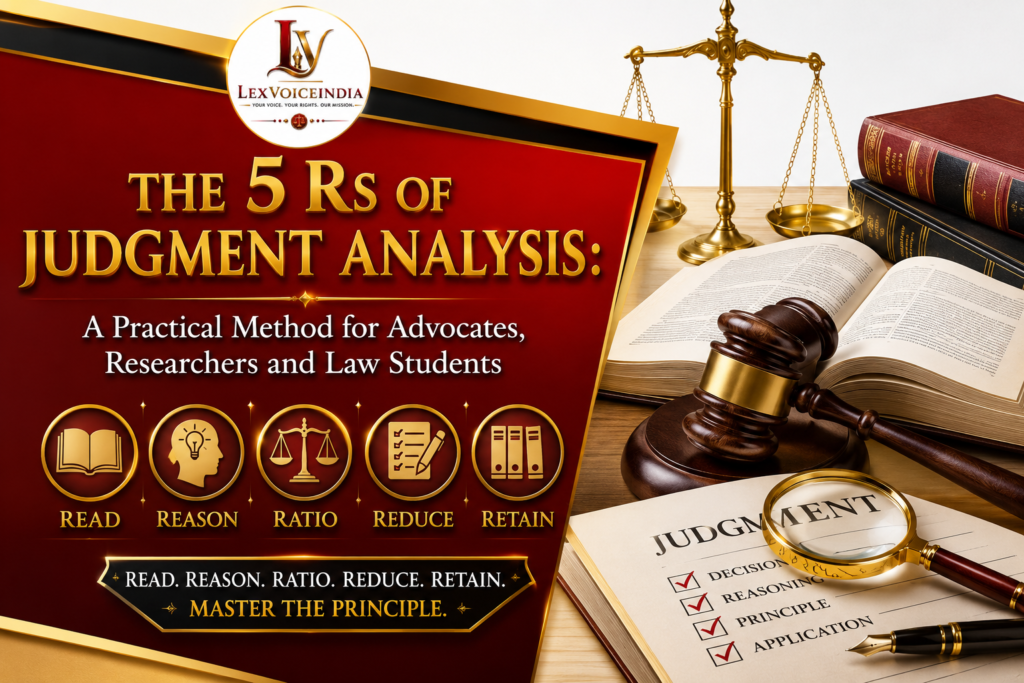
A Disciplined Approach to Reading, Understanding, Distilling and Applying Judicial Decisions
A Judgment Is More Than Its Final Order
A judgment is not merely a document recording who succeeded and who failed. For an advocate, researcher or law student, its real value lies in understanding what the Court decided, why it decided it, what legal principle was necessary for that decision, and how that principle may legitimately be applied in another case.
A judgment may run into dozens or even hundreds of pages. It may contain pleadings, factual history, statutory provisions, submissions of counsel, discussion of earlier authorities, alternative arguments, observations and the final operative directions. Merely reading all those pages does not necessarily mean that the judgment has been understood.
The real skill lies in moving from the judgment as a whole to the legal proposition that can accurately be understood, remembered, researched and applied.
For practical legal research, this process can be organised through the 5 Rs of Judgment Analysis:
The 5 Rs are a practical framework created for disciplined legal analysis. They are not a statutory formula, nor a formally recognised legal doctrine. Their purpose is methodological: to help an advocate approach a judgment systematically rather than extract an isolated sentence merely because it appears favourable.
READ
Understand the Case Before Searching for the Proposition
The first discipline is READ.
Before asking what proposition a judgment supports, the advocate must understand the case in its proper factual and procedural setting.
A judgment should ordinarily be read with attention to:
- Material facts
- Procedural history
- Pleadings and rival submissions
- Issues arising for determination
- Relevant statutory provisions
- Evidence or circumstances material to the controversy
- Findings of the Court
- The ultimate relief or order
What actually happened, and what question did the Court have to decide?
This question sounds simple, but it prevents one of the most common errors in legal research: beginning with a favourable sentence and then attempting to construct an argument around it.
Facts provide the context within which legal principles operate. The same statutory provision may produce different legal consequences depending upon the factual circumstances, the issue actually raised and the relief sought.
A statement appearing broad when read independently may be significantly qualified when read in the context of the facts, the issue framed and the reasoning adopted by the Court.
For that reason, an advocate should resist the temptation to search a judgment merely for keywords. Keyword-based reading can locate a passage; it cannot, by itself, establish the legal significance of that passage.
The judgment must first be understood as a whole.
What happened, what was in dispute, and what exactly was the Court called upon to determine?
REASON
Understand Why the Court Decided the Case
The second discipline is REASON.
After understanding the factual and procedural background, the advocate must follow the intellectual path by which the Court reached its conclusion.
The advocate should ask:
- What statutory provision or legal rule governed the dispute?
- How did the Court interpret that provision?
- What earlier decisions were considered?
- Were any precedents distinguished because of differences in facts or legal issues?
- Were any arguments rejected, and if so, why?
- How did the Court connect the governing legal principle with the facts before it?
- And, ultimately, why did the Court arrive at the conclusion recorded in the judgment?
Result
Tells us what the Court decided.
Reasoning
Explains why the Court decided it.
For advocacy, the second question is often more important. A future case may not reproduce the same facts, but it may involve a similar legal issue. An advocate who understands the reasoning can examine whether the principle genuinely travels to the new factual situation.
An advocate who has memorised only the final result may struggle when the facts change.
An advocate who understands the reasoning can identify both the reach and the limits of the precedent.
Why did the Court decide the case in this particular manner?
RATIO
Identify the Principle That Actually Decided the Case
The third discipline is RATIO.
This is the central stage of judgment analysis.
The expression ratio decidendi generally refers to the legal principle or proposition that is necessary for the Court’s decision on the issue before it. It is the principle which, in the context of the case, provides the legal foundation for the result.
However, identifying ratio decidendi is not always a matter of locating one sentence in a judgment. A judgment may contain extensive discussion of earlier cases, hypothetical situations, general observations, alternative reasoning and explanatory passages. Not every statement carries the same precedential significance.
The advocate must distinguish between these concepts:
Judgment
The Court’s decision as expressed in its reasons and operative directions.
Reasoning
The process through which the Court analyses the facts and law to arrive at its conclusion.
Ratio Decidendi
The legal principle necessary for the decision on the issue actually determined.
Obiter Dicta
Observations not necessary for the determination of the case (though they may still have persuasive value).
The distinction is important because a sentence appearing in a judgment does not automatically become the ratio decidendi of that judgment. The advocate must examine the sentence in connection with the material facts, the issue, the applicable law and the reasoning that led to the result.
This is particularly important when dealing with long judgments. A paragraph may contain an attractive statement of law, but the real question is whether that proposition was necessary for the decision actually rendered.
“Where does the judgment say something favourable to my case?”
“What legal proposition was necessary for the Court to decide the issue before it?”
This approach also helps prevent the practice of citing observations outside their factual and legal context.
What is the legal principle that I can legitimately take from this decision?
REDUCE
Convert the Judgment into a Precise Legal Proposition
The fourth discipline is REDUCE.
Judgments are often lengthy because courts must explain the facts, consider competing arguments, examine statutory provisions, deal with precedents and provide reasons for the conclusions reached.
An advocate, however, usually cannot reproduce an entire judgment every time an authority is cited.
Legal research therefore requires the ability to reduce a judgment without distorting it.
A properly reduced proposition should ordinarily make clear:
- What is the legal rule or principle?
- In what circumstances does it operate?
- Which facts are material to its application?
- What limitations or qualifications emerge from the judgment?
The purpose of reduction is not to make the proposition as broad as possible.
The purpose is to make it as accurate as possible.
This distinction is fundamental to responsible advocacy.
“Delay always defeats specific performance.”
“Prolonged delay, considered with the other relevant circumstances, including the conduct of the parties and the equitable nature of the relief sought, may support refusal of specific performance.”
The second formulation is more legally responsible because it does not convert one consideration into an absolute rule.
The exact proposition must, of course, always be verified against the particular judgment being cited.
A good legal proposition should be sufficiently concise to be useful while retaining the qualifications necessary to prevent distortion.
Can I state the principle accurately and briefly without changing what the Court actually decided?
RETAIN
Preserve the Principle for Future Research and Advocacy
The fifth discipline is RETAIN.
Legal research is rarely a one-time exercise. A judgment studied today may become relevant months or years later in a completely different matter.
Therefore, understanding a judgment is only part of the task. The advocate must also preserve the information in a form that can be retrieved when required.
A Useful Research System May Include:
The most useful record is not necessarily the longest one.
Specific Performance → Readiness & Willingness → Delay → Conduct → Equitable Relief
Constitutional Law → Article 14 → Arbitrariness → Classification
Criminal Law → Bail → Custody → Investigation → Personal Liberty
Such indexing allows the advocate to retrieve not merely the name of a case, but the legal issue for which the case may be relevant.
“I remember this judgment.”
“I know what principle it contains, the issue on which it was decided, the factual context in which it arose, and where it may legitimately be used.”
Will I be able to find, understand and use this authority when the same or a related issue arises in the future?
THE 5 Rs IN ONE VIEW
The entire method can be remembered through five questions:
READ
What happened?
REASON
Why did the Court decide that way?
RATIO
What legal principle actually decided the issue?
REDUCE
How can that principle be stated accurately and briefly?
RETAIN
How will I preserve and retrieve it for future use?
This converts judgment reading from a passive exercise into a structured research process.
WHY THE 5 Rs MATTER IN LEGAL PRACTICE
The 5 Rs provide a repeatable method for moving from a lengthy judicial decision to a proposition that can be responsibly used in legal work.
This method is particularly useful because legal arguments are not strengthened merely by accumulating authorities.
The strength of an authority depends upon whether the issue decided, the legal principle and the factual context genuinely support the proposition for which the authority is being cited.
A judgment should therefore not be cited simply because it contains a sentence that appears favourable.
Before relying upon a precedent, an advocate should examine at least four things:
What issue was decided?
What facts were material?
What reasoning led to the conclusion?
What principle was actually necessary for the decision?
The 5 Rs bring these questions into one disciplined framework.
THE 5 Rs APPLY ACROSS DIFFERENT BRANCHES OF LAW
The method is not confined to one particular field.
It can be applied to judgments involving:
But the fundamental discipline of judicial analysis remains substantially the same: understand the case, understand the reasoning, identify the governing principle, state it accurately and preserve it for future use.
A PRACTICAL 5-R TEST BEFORE CITING ANY JUDGMENT
Before citing an authority in a pleading, written submission, research note or oral argument, an advocate can ask five simple questions.
READ
Have I understood the material facts, procedural history and issue decided by the Court?
REASON
Do I understand the legal reasoning by which the Court reached its conclusion?
RATIO
Have I identified the principle that was actually necessary for the decision?
REDUCE
Can I state that principle accurately without taking it beyond the limits of the judgment?
RETAIN
Can I retrieve the authority and explain its factual and legal context if the Court asks me about it?
If the answer to all five questions is yes, the advocate has moved beyond merely reading a judgment and has begun to understand and analyse it.
A NOTE ON RESPONSIBLE USE OF PRECEDENT
Good judgment analysis also requires intellectual discipline.
An advocate should distinguish between a proposition that is binding, one that is persuasive, and an observation that may have limited relevance depending upon the authority and circumstances.
The precedential value of a judicial decision cannot be determined merely by counting the number of times a particular sentence appears in subsequent research results.
The court, the nature of the decision, the issue decided, the applicable legal framework, the material facts and the reasoning adopted all matter.
Similarly, a later judgment may explain, distinguish, limit or develop an earlier proposition.
Therefore, RETENTION should not mean storing an isolated quotation forever. It should mean preserving the authority together with its legal context.
A Good Case-Law Note Should Ideally Contain:
FROM READING TO ADVOCACY
The ultimate purpose of judgment analysis is not academic memorisation.
It is effective legal reasoning.
When an advocate understands why a court reached a particular conclusion, the advocate can better determine whether the principle supports the client’s case, whether the factual differences are material, whether the authority can be distinguished, and whether a later authority has altered its application.
This makes judgment analysis particularly valuable in drafting.
A well-drafted pleading or written submission does not merely reproduce passages from judgments. It identifies the legal proposition, explains its relevance and demonstrates how the principle applies to the facts of the case being argued.
That is where legal research becomes advocacy.
THE 5 Rs AS A DAILY LEGAL RESEARCH HABIT
The 5 Rs need not be reserved for landmark constitutional judgments or lengthy Supreme Court decisions.
They can become part of everyday legal research.
Whenever an advocate encounters a potentially useful authority, five short notes can be made:
READ
What happened?
REASON
Why did the Court decide as it did?
RATIO
What principle was necessary for the decision?
REDUCE
What is the precise proposition?
RETAIN
Where should this authority be stored and when might it be useful?
Over time, this practice can create a personal legal research system.
Instead of repeatedly starting from the beginning every time an issue arises, the advocate develops an organised body of authorities arranged around issues and principles rather than merely case names.
That is particularly valuable in active practice, where research often has to be undertaken under significant time constraints.
CONCLUSION
A judgment should not end with the last page of a PDF.
Its real value begins when the advocate understands the dispute, the issue, the reasoning and the legal principle that supports the decision, and then knows how to use that principle without extending it beyond its legitimate limits.
The method is simple, but the discipline behind it is significant.
A judgment properly understood today may become an important authority in the case argued tomorrow.
The objective is therefore not merely to read more judgments.
It is to understand them better, extract their principles accurately and use them responsibly.
READ THE JUDGMENT. MASTER THE PRINCIPLE.
Happy Independence Day
From LexVoiceIndia to every Indian across the globe
Leave a Reply
Explore Legal Categories
Deep insights across every major area of law
Constitutional Law
Fundamental Rights & GovernanceCriminal Law
IPC, CrPC & Landmark RulingsCivil Law
Contracts, Torts & PropertyCorporate Law
Companies Act & M&AFamily Law
Marriage, Divorce & CustodyIntellectual Property
Patents, Trademarks & CopyrightLabour & Employment
Industrial Disputes & WagesTaxation
Income Tax, GST & Direct TaxCyber Law
IT Act & Digital CrimesHuman Rights
Liberty, Equality & DignityArbitration
ADR & Commercial DisputesEnvironmental Law
Climate, Pollution & Green LawIN DEVELOPMENT & SCHEDULED RELEASE
Part 1: The Evidentiary Audit of Electronic Records
Advocacy Framework by G. Aruna Reddy
Advance preview materials and full analysis scheduled for release shortly.