
Supreme Court of India
Explore the latest judgments, orders, important case law and constitutional developments from the Supreme Court of India.
Constitutional Authority • Landmark Judgments • Justice in Action
Brief of the Case Law
Reji Baby v. Subi Mary & Ors., 2026 INSC 918 — Criminal Appeal No. 1346 of 2021, decided on 24 August 2026.
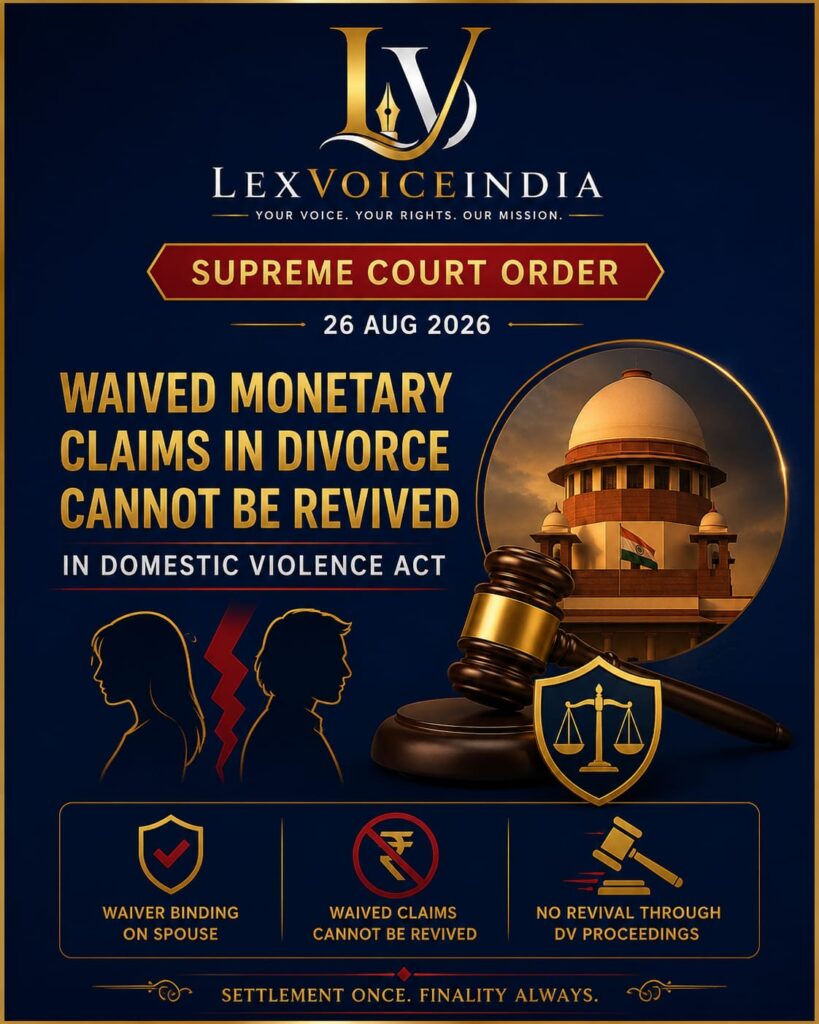
The Supreme Court held that where a wife has voluntarily and expressly relinquished her monetary claims, including maintenance, under a matrimonial settlement that was subsequently reaffirmed, such claims cannot ordinarily be revived through proceedings under the Domestic Violence Act in respect of the same pre-settlement claims. In the absence of a successful legal challenge to the settlement or divorce decree, allegations of coercion alone were insufficient to undo the settlement.
The Court, however, distinguished the independent rights of the adult daughter, who was not a party to the settlement. Her monetary rights could not be treated as waived, and she was left at liberty to pursue appropriate remedies in accordance with law.
Held :
The appeal was allowed, the Kerala High Court’s order was set aside, and the proceedings against the husband were quashed, while the daughter’s independent rights were preserved.
Legal Principle:
A voluntary and reaffirmed matrimonial settlement expressly relinquishing monetary and maintenance claims cannot ordinarily be circumvented by reviving the same pre-settlement claims through DV Act proceedings. The settlement does not, however, extinguish the independent rights of a person who was not a party to it.
LexVoiceIndia
Case Laws Series
Reliance on AI-Generated Fake and Hallucinated Case Law by Courts and Tribunals — Sanctity of Judicial Decision-Making
Background
The appellant, Pooja Ramesh Singh, was a suspended director of Essel Infraprojects Ltd. (EIL), which had stood as corporate guarantor for a borrower, Pan India Utilities Distribution Company Ltd. (PIUDCL).
After default in repayment of the loan facilities, Jammu and Kashmir Bank Ltd. initiated proceedings under Section 7 of the Insolvency and Bankruptcy Code, 2016, before the National Company Law Tribunal (NCLT), Mumbai.
The NCLT admitted the insolvency application on 28 August 2024. The appellant challenged the decision before the National Company Law Appellate Tribunal (NCLAT), but the appeal was dismissed on 11 September 2025.
Issue Before the Supreme Court
The Supreme Court considered, among other things:
- Whether the decisions of the NCLT and NCLAT could be sustained when they relied upon six citations that were subsequently found to be fake, non-existent or attributed to non-existent paragraphs.
- What safeguards and directions were necessary concerning the use of AI-generated or hallucinated legal material as judicial precedent.
What the Court Found
The Supreme Court independently examined the citations. It found that:
- Two citations had correct case references but were attributed to non-existent paragraphs.
- One citation belonged to an actual judgment, but the paragraph attributed to it did not exist.
- Three citations were completely non-existent.
- The material had nevertheless been relied upon by the NCLT and subsequently escaped scrutiny before the NCLAT.
Decision of the Supreme Court
The Supreme Court set aside the judgments and orders of the NCLT and NCLAT.
The Section 7 insolvency application was restored to its original number and remitted to the NCLT for fresh disposal on merits.
The Court also adopted a zero-tolerance approach towards the production, citation or reliance upon AI-generated fake or hallucinated precedents without verification.
The Court directed the Bar Council of India to constitute a committee to consider the issue of advocates submitting fake or hallucinated material as legal precedent and to prescribe appropriate guiding principles and disciplinary consequences.
Ratio / Legal Principle
A judicial decision based upon fake or hallucinated legal material cannot be sustained in law. The Supreme Court emphasized that the legitimacy and sanctity of adjudication depend upon the authenticity of the legal authorities placed before the Court. Reliance upon non-existent precedents or fabricated passages undermines the judicial process and the rule of law.
Final Directions
The Supreme Court:
- Set aside the NCLT and NCLAT decisions.
- Restored the Section 7 application.
- Remitted the matter to the NCLT for fresh consideration on merits.
- Directed the Bar Council of India to constitute a committee concerning AI-generated fake/hallucinated legal material.
- Emphasised verification of authorities before they are relied upon in judicial proceedings.
Significance
This judgment is particularly significant for the legal profession because it addresses the emerging problem of AI-generated hallucinations in legal research and judicial proceedings.
The Court did not prohibit legitimate use of AI. Its concern was specifically with presenting fabricated or hallucinated material as genuine legal precedent without verification.
Official Source
Official Supreme Court source: The Supreme Court’s Landmark Judgment Summaries page provides the case details and a link to the full judgment.
Supreme Court of India — Landmark Judgment Summaries
Outcome
Judgments of NCLT and NCLAT set aside. Section 7 application restored and remitted to NCLT for fresh disposal on merits. Directions issued to Bar Council of India.