
Published On 21/09/2026
Author – Lexvoiceindia -G.Aruna
Secular Administration of Religious Institutions:
The Constitutional Boundary Between Religion and Governance
Introduction
The constitutional protection of religion does not mean that every activity connected with a religious institution is itself a matter of religion.
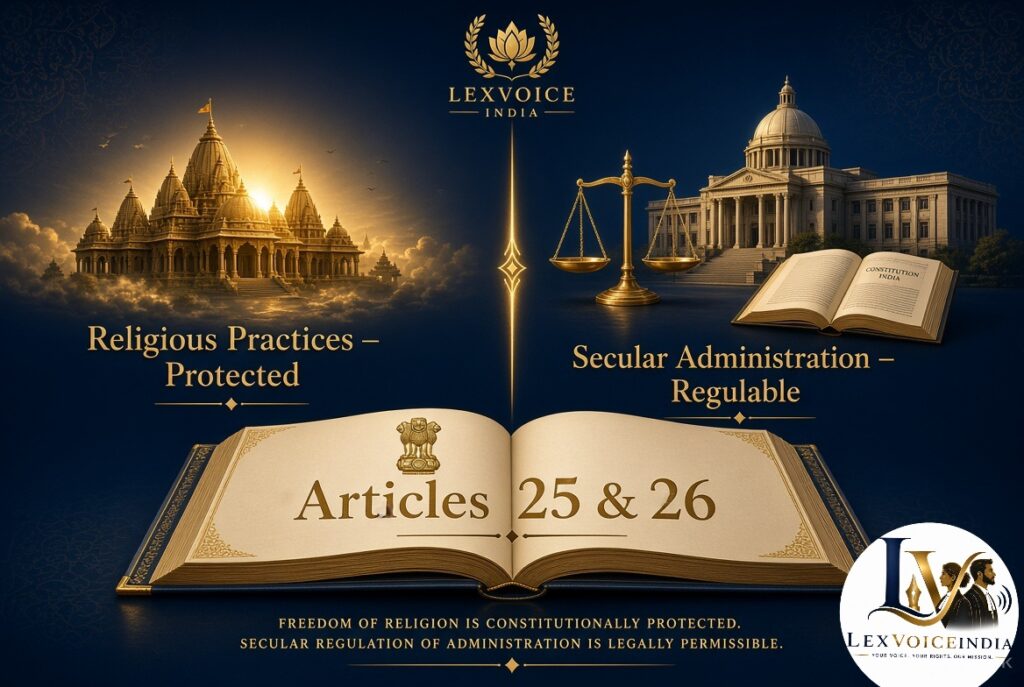
A recurring question under Articles 25 and 26 of the Constitution of India is where the constitutional protection of religious practice ends and the State’s authority to regulate the secular administration, management and governance of religious institutions begins.
The Supreme Court’s decisions, arising in different factual and statutory contexts, have repeatedly examined this distinction.
The central principle emerging from these authorities is:
The mere fact that an activity occurs within a temple or religious institution, therefore, does not by itself determine its constitutional character.
1. The Constitutional Starting Point: Religion and Secular Activity
Articles 25 and 26 protect religious freedom, but the constitutional scheme itself recognizes a distinction between religious matters and secular activities associated with religion.
Article 25(2)(a) expressly permits the State to regulate or restrict economic, financial, political or other secular activity which may be associated with religious practice.
Article 26 separately protects the right of a religious denomination to manage its own affairs in matters of religion, while Article 26(d) concerns administration of property in accordance with law.
Thus, the constitutional text itself does not treat every activity connected with religion as immune from regulation.
The important legal question is the true character of the particular activity.
2. Tilkayat Shri Govindlalji Maharaj: Temple Property and Secular Management
In Tilkayat Shri Govindlalji Maharaj v. State of Rajasthan, the Supreme Court considered the administration of the Nathdwara temple and its properties.
The Court drew a distinction between matters genuinely belonging to religion and matters concerning the administration and management of temple property.
Importantly, the Court observed that where an activity is essentially secular, it does not become a protected religious practice merely because it is connected with a religious institution.
The Court specifically treated the right to manage temple property as a secular matter rather than a religious practice or an affair in matters of religion.
The case provides an important foundation for the proposition that: The religious character of a temple does not convert the administration of its property into a religious practice.
3. Pannalal Bansilal Pitti: Administration and Maintenance
In Pannalal Bansilal Pitti v. State of Andhra Pradesh, the Supreme Court considered statutory regulation concerning Hindu religious and charitable institutions.
The Court recognized the distinction between religious practices, on the one hand, and the administration and maintenance of religious and charitable institutions, on the other.
The judgment describes administration and maintenance as secular activities while preserving the distinction concerning established religious practices.
The case supports the proposition that statutory regulation of the institutional and administrative structure of a religious endowment does not, merely for that reason, amount to regulation of religious practice.
The proposition should, however, remain confined to the administrative and statutory issues actually considered in the case.
4. Bhuri Nath: Religious/Customary Rights and Administration
Bhuri Nath v. State of Jammu & Kashmir concerned the administration of a religious shrine and issues involving customary and service rights.
The case is relevant to the broader constitutional distinction between religious or customary rights and the secular aspects of institutional administration and service arrangements.
It should, however, be used with precision.
It is not the principal authority for the legal character of offerings and their collection or distribution. That proposition is more directly addressed in the Jagannath Temple decision discussed below.
Bhuri Nath is therefore best treated as a supporting authority illustrating the need to distinguish genuine religious/customary rights from secular institutional matters.
5. Kashi Vishwanath: Religious Affairs and Secular Administration
In Sri Adi Visheshwara of Kashi Vishwanath Temple, Varanasi v. State of U.P., the Supreme Court considered statutory measures concerning the management and administration of the temple.
The Court recognized the distinction between the religious affairs of the institution and its secular management and administration.
The statutory scheme sought better and proper management while preserving the religious functions and practices of the temple.
The Court also recognized the entrustment of the secular side of administration to statutory authorities.
The decision demonstrates that: Regulation of the secular administration of a religious institution is not, merely because the institution is religious, an impermissible interference with religious practice.
The distinction is between control of secular management and interference with matters genuinely belonging to religion.
6. Jagannath Temple: Offerings and Their Subsequent Management
The decision in State of Orissa v. Sri Jagannath Temple Puri Management Committee / Chintamani Khuntia, (1997) 8 SCC 422, is particularly important for the financial and administrative dimension of the principle.
The Court examined the nature of activities concerning offerings made by devotees.
The Court distinguished the religious act of making an offering from the subsequent collection, distribution and retention of money for the maintenance and upkeep of the temple.
Those subsequent activities were treated as matters of secular management and administration.
This provides a particularly clear illustration of the constitutional distinction: An activity may originate in a religious act without every subsequent activity concerning it becoming a religious practice.
Thus, the religious character of an offering does not necessarily make its subsequent financial administration a matter of religion.
This is one of the strongest authorities for the central proposition of this Legal Insight.
7. M.P. Gopalakrishnan Nair: Later Reaffirmation
In M.P. Gopalakrishnan Nair v. State of Kerala, (2005) 11 SCC 45, the Supreme Court considered issues concerning temple administration and referred to the earlier jurisprudence concerning religious institutions.
The judgment specifically records the principle from Sri Adi Visheshwara that:
The judgment also discusses the earlier authorities concerning the distinction between religious practice and secular administration.
The appeals were ultimately dismissed.
This later decision strengthens the continuity of the principle that: religious freedom does not place the secular administration of religious institutions outside the operation of law.
8. What the Supreme Court Authorities Collectively Establish
These judgments arose in different factual and statutory contexts. They should therefore not be described as if each decided the identical question.
Nevertheless, read together, they illuminate a consistent constitutional distinction:
Religious sphere
- genuine religious practices;
- affairs genuinely concerning religion;
- constitutionally protected religious observances, subject to the Constitution.
Secular sphere
- institutional administration;
- management and governance;
- administration of temple property;
- maintenance and upkeep;
- financial and economic activities of the institution;
- collection and distribution of offerings where treated as secular management.
The second category may be regulated by law, subject to constitutional limitations.
9. The Principle in Its Most Precise Form
The safest formulation for legal research purposes is:
This formulation avoids two opposite errors.
It does not say that the State can freely interfere with religion.
Nor does it say that everything occurring within a religious institution is constitutionally immune from regulation.
The constitutional inquiry must instead focus on the nature and character of the activity being regulated.
10. Justice Abhay S. Oka — Contemporary Constitutional Perspective
A separate contemporary perspective comes from remarks attributed to Justice Abhay S. Oka at a public judicial event in March 2024 concerning the performance of religious rituals during official court programmes.
This material should be described accurately as public remarks by Justice Oka, rather than as a judgment or binding precedent of the Supreme Court.
Its relevance to this Legal Insight is contextual: it raises questions concerning the place of constitutional values and religious practices within official judicial institutions.
It should therefore not be cited as authority for the secular-administration doctrine established by the Supreme Court cases above.
11. Bhojshala: A Contemporary, Fact-Specific Judicial Decision
The 2026 Madhya Pradesh High Court decision concerning Bhojshala/Kamal Maula Mosque provides a contemporary example involving religious character, historical and architectural material, archaeological evidence and statutory administration of a protected monument.
The Court’s operative directions addressed the character of the protected site and matters concerning preservation, conservation, regulation of access and administration under the applicable statutory framework.
This decision should, however, be presented on its own factual and statutory footing.
It should not be converted into a broad proposition that scientific evidence universally overrides religious belief. The legal conclusions in that case arose from the evidence and statutory framework before the Court.
12. The Constitutional Balance
The jurisprudence therefore does not establish a constitutional conflict between religion and governance as such.
It establishes a constitutional boundary.
Religion receives constitutional protection.
Secular administration remains subject to law.
The existence of a religious institution does not, by itself, place all of its activities beyond regulatory authority.
Conversely, the characterization of an activity as “administrative” cannot by itself justify interference with a matter that constitutionally belongs to religion.
The decisive question is:
- What is the true character of the activity sought to be regulated?
- Is it genuinely a matter of religion?
- Or is it a secular matter of administration, management, property, finance or institutional governance?
That distinction lies at the heart of the jurisprudence.
Conclusion
The Supreme Court’s decisions concerning religious institutions demonstrate that constitutional protection of religious freedom and lawful regulation of secular administration can operate simultaneously.
A religious institution may remain fully protected in respect of its genuine religious practices while its property, administration, finances, maintenance and other secular affairs remain subject to regulation in accordance with law.
The constitutional principle is therefore not one of State control over religion, nor of complete immunity of religious institutions from regulation.
It is a principle of constitutional classification:
That is the constitutional boundary between religious freedom and secular governance.
Authorities Considered
Leave a Reply