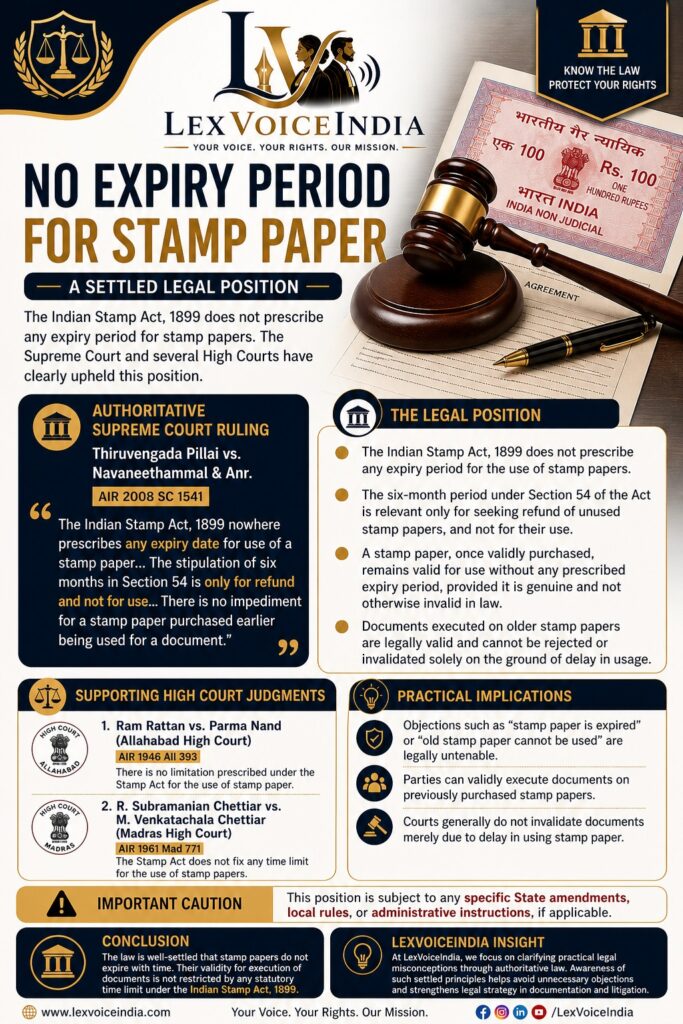
A frequent misconception in legal and commercial practice is that stamp papers lose their validity if not used within six months. This belief is legally incorrect.
Under the scheme of the Indian Stamp Act, 1899, there is no provision prescribing any expiry period for the use of stamp papers. This position has been conclusively settled by judicial pronouncements.
Authoritative Supreme Court Ruling
The Hon’ble Supreme Court in
Thiruvengada Pillai vs. Navaneethammal & Anr.
held:
“The Indian Stamp Act, 1899 nowhere prescribes any expiry date for use of a stamp paper… The stipulation of six months in Section 54 is only for refund and not for use… There is no impediment for a stamp paper purchased earlier being used for a document.”
Supporting Judicial Precedents
. Ram Rattan vs. Parma Nand (Allahabad High Court)
There is no limitation prescribed under the Stamp Act for the use of stamp paper.
. R. Subramanian Chettiar vs. M. Venkatachala Chettiar (Madras High Court)
The Stamp Act does not fix any time limit for the use of stamp papers.
Legal Position Explained
. The Indian Stamp Act, 1899 does not prescribe any expiry period for stamp papers.
. The six-month period under Section 54 applies only for seeking refund, not for use.
. A stamp paper remains valid for use, as no expiry period is prescribed under the Indian Stamp Act, 1899.
. Documents executed on older stamp papers cannot be invalidated solely on that ground.
Practical Implications
. Objections such as “stamp paper is expired” are legally untenable.
. Parties can validly execute documents on previously purchased stamp papers.
. Courts generally do not invalidate documents merely due to delay in usage.
Important Caution
This position is subject to any specific State amendments, local rules, or administrative instructions, if applicable.
Conclusion
Stamp papers do not expire with time. Their validity for execution of documents is not restricted by any statutory time limit under the Indian Stamp Act, 1899.
LexVoiceIndia Insight
At LexVoiceIndia, we aim to simplify complex legal principles and dispel common misconceptions. Understanding such settled legal positions helps individuals and businesses avoid unnecessary disputes and strengthens legal documentation practices