
Published on 08 / 09 / 2026
Author Adv G. Aruna / LexVoiceIndia
LexVoiceIndia Special Feature

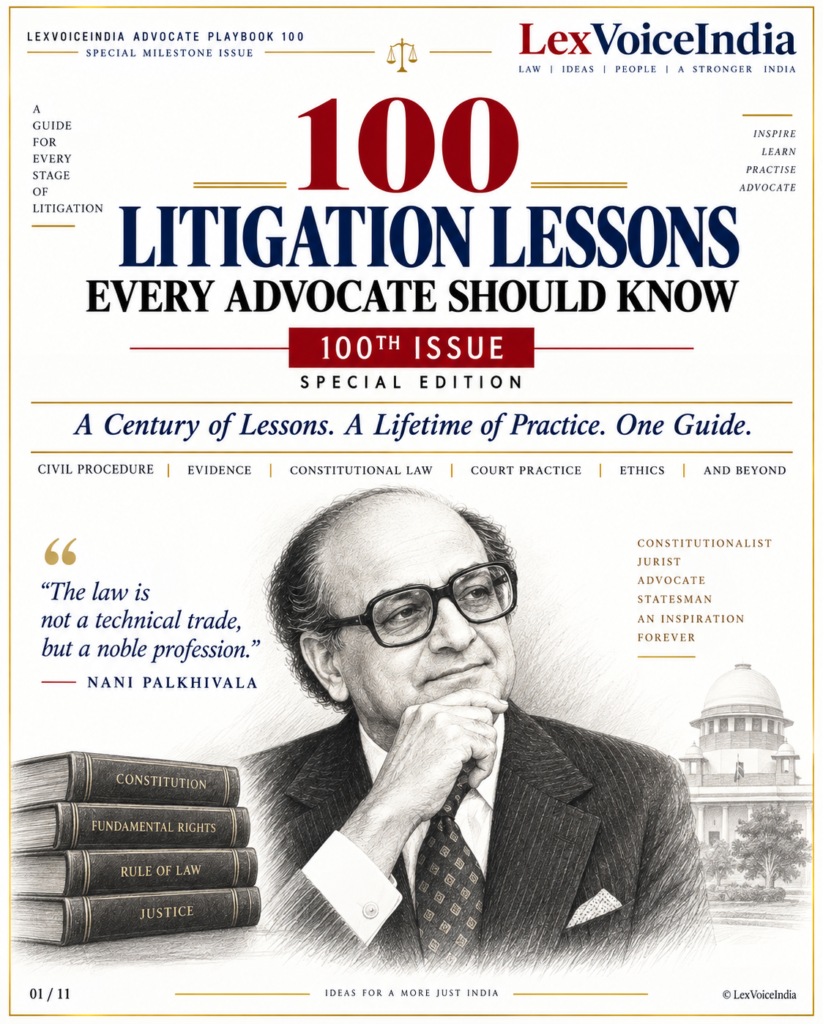
100 Litigation Lessons from the Palkhivala School of Advocacy

How to Think, Prepare, Argue and Practise Like a First-Class Advocate

LexVoiceIndia Editorial · September 2026
01
Clarity of thought
02
Depth of preparation
03
Precision of proposition
04
Mastery of the record
05
Command of the courtroom

Nani Palkhivala did not merely argue cases. He elevated the practice of advocacy into an art of clarity, preparation, and intellectual honesty. These 100 lessons distill the essence of that school — not as courtroom tricks, but as a complete way of thinking, preparing, and presenting a case.

The Palkhivala standard: An advocate must know the facts better than anyone else in the room, understand the law with precision, and present both with such economy and force that the court is left with no room for confusion.

Why These Lessons Matter

Most young advocates begin with statutes and citations. The Palkhivala school begins earlier — with the quality of thought itself. Clarity before volume. Preparation before performance. Precision before persuasion.

These 100 lessons are organised to take an advocate from the first reading of the brief to the final executable order, guided by the same discipline that defined one of India’s greatest advocates.

LexVoiceIndia
One Bar · One Voice · Stronger Advocacy
Editorial Note

This is an original LexVoiceIndia study of the documented professional methods and advocacy principles associated with N. A. Palkhivala. It is not authored by N. A. Palkhivala, does not reproduce his writings, and does not purport to present these lessons as his personal rules.

Introduction
There are advocates who know the law. There are advocates who know the facts. There are advocates who speak beautifully. And there are rare advocates who can bring law, facts, principle, language and courtroom judgment together at precisely the moment they are needed.

Nani Ardeshir Palkhivala belonged to that rare category.

His career cannot be reduced to his celebrated constitutional arguments. He practised in taxation, constitutional law and several other fields, appeared before different courts and tribunals, taught law, wrote extensively and represented India internationally. His professional range was considerable.

But what makes his career especially valuable for today’s advocate is something more practical:
His method.

Accounts of his practice describe a lawyer who did not simply accumulate information. He absorbed it, organised it, reduced it to propositions and then presented the decisive points with extraordinary clarity.

His written propositions in Kesavananda Bharati provide an extraordinary example of that method. Rather than beginning with a broad assertion, the document isolates the precise interpretive questions concerning “law” and “amendment” and builds the constitutional submission from there.

That is the Palkhivala lesson worth carrying into modern practice.

The great advocate is not the person who knows the most words.
It is the person who can find the right proposition, support it with the right law and facts, and explain it so clearly that the court can work with it.

The following 100 lessons are therefore not attributed to Palkhivala as quotations or as rules he personally wrote. They are an original LexVoiceIndia synthesis of the documented features of his professional method, translated into practical lessons for contemporary advocates.

III. THE JUNIOR ADVOCATE’S ROLE

Lessons 21 – 30

Palkhivala’s practice also offers an important lesson about the relationship between senior and junior counsel: written work should be precise, organised and useful, not merely voluminous. Accounts of his practice specifically mention his preference for written notes from juniors.
21
A junior’s job is not to send pages.
The objective is to send useful analysis.
22
Write the proposition clearly.
Do not make senior counsel discover your conclusion buried on page 27.
23
Give the authority with the proposition.
For example:
Proposition — Authority — Relevant paragraph — Why applicable.
24
Separate binding authorities from persuasive material.
Not every judgment carries the same weight.
25
Identify adverse authorities too.
A good research note should not hide inconvenient law.
26
Explain why an adverse authority can be distinguished—if it can.
Do not merely list it.
Analyse it.
27
Never send an authority you have not read.
A citation is a professional responsibility.
28
Don’t confuse length with diligence.
A 5-page note that answers the question can be better than a 50-page compilation that does not.
29
Give the senior counsel a usable roadmap.
The purpose of research is to make decision-making easier.
30
Learn to anticipate the next question.
If your proposition is X, ask:
“What is the strongest objection to X?”
Answer that too.

IV. RESEARCH LIKE PALKHIVALA

Lessons 31 – 40

31
Research widely before arguing narrowly.
Deep research gives you confidence to make a concise submission.
32
Read primary sources first.
Start with:
Statute → Constitution → Judgment → Rules → Secondary material.
33
Understand the history when the issue requires it.
Constitutional interpretation may require historical material.
Palkhivala’s major constitutional preparation illustrates the value of extensive background research.
34
Use comparative law intelligently.
Foreign law may illuminate a principle.
It does not automatically determine Indian law.
35
Do not collect authorities merely to impress.
The goal is persuasion, not decoration.
36
Choose the strongest authorities.
A few directly applicable cases can be more effective than a long list.
37
Know the ratio.
Do not mistake an observation for the holding.
38
Read the factual context.
A proposition cannot always be detached from the circumstances in which it was decided.
39
Check subsequent treatment.
A judgment may have been distinguished, limited, overruled or affected by legislation or constitutional change.
40
Turn research into propositions.
Research becomes advocacy only after it is organised into usable propositions.

V. DRAFT WITH PRECISION

Lessons 41 – 50

41
Write for the judge.
Not for your own satisfaction.
42
Signpost the argument.
Tell the court where you are going.
Then take it there.
43
Put the strongest proposition where it can be seen.
Do not hide your central submission.
44
Use headings intelligently.
A well-structured written submission helps the court navigate the argument.
45
Eliminate repetition.
Repeating an assertion does not make it legally stronger.
46
Replace adjectives with facts.
Instead of saying:
“The order is blatantly arbitrary.”
Explain precisely why the order is legally vulnerable.
47
Use quotations sparingly.
Quote the decisive language.
Do not turn submissions into a collection of quotations.
48
Distinguish fact from submission.
Make clear what is established on record and what you are asking the court to infer.
49
End every major section with the legal consequence.
The court should know:
“Therefore, what follows?”
50
Edit ruthlessly.
Good advocacy is often improved by removing words.

VI. COURTROOM ADVOCACY

Lessons 51 – 60

Palkhivala was remembered not merely for knowledge but for court craft, clarity, precision, persuasive force and the ability to think on his feet.
51
Enter court prepared to answer questions.
Not merely prepared to deliver a speech.
52
Listen before responding.
The question may reveal the court’s real concern.
53
Answer the question asked.
Do not evade a difficult question with an unrelated submission.
54
Then give the explanation.
Direct answer first.
Reason second.
55
Have alternative answers ready.
If proposition A fails, know whether proposition B or C legitimately remains available.
56
Never manufacture an answer.
If you do not know, say so and seek appropriate time to verify.
57
Keep your voice controlled.
Persuasion does not require aggression.
58
Treat opposing counsel with professional respect.
Palkhivala’s courtroom manner was remembered for courtesy and dignity rather than arrogance.
59
Do not interrupt unnecessarily.
Listen carefully.
60
Know when to stop.
The last unnecessary sentence can weaken the previous ten good ones.

VII. THE ART OF THE PROPOSITION

Lessons 61 – 70

61
Reduce every argument to one sentence.
If you cannot state the proposition clearly, you may not yet understand it clearly.
62
Then identify the authority.
Proposition → Authority.
63
Then identify the factual application.
Authority → Facts.
64
Then identify the consequence.
Facts → Relief.
65
Never confuse assertion with demonstration.
Saying “the law is settled” is not a substitute for showing the law.
66
Build arguments like architecture.
Each proposition should support the next.
67
Do not make five arguments when one is decisive.
But always know your legitimate alternatives.
68
Anticipate the weakest link.
Every chain of reasoning has one.
Find yours first.
69
Make the judge’s decision easier.
A persuasive submission should help the court write the reasoning that supports the conclusion you seek.
70
Precision is persuasion.
Accuracy creates credibility.

VIII. CROSS-EXAMINATION THROUGH THE PALKHIVALA LENS

Lessons 71 – 80

71
Cross-examine for a reason.
Never question a witness simply because there is time.
72
Decide what admission you need.
Then design the questions around it.
73
One fact at a time.
Controlled questioning produces controlled evidence.
74
Use the record.
The witness’s previous statement or document may be more powerful than confrontation.
75
Establish contradictions correctly.
Follow the applicable evidentiary procedure.
76
Do not fight the witness unnecessarily.
The object is evidence, not theatre.
77
Do not ask a question whose answer may damage your case unless the risk is justified.
78
Know when you have won the point.
Stop when the objective has been achieved.
79
Maintain composure.
A calm advocate is easier for the court to trust.
80
Let the evidence do the work.
The advocate’s job is often to expose what the record already demonstrates.

IX. CONSTITUTIONAL ADVOCACY

Lessons 81 – 90

Palkhivala’s constitutional legacy is inseparable from landmark cases including Kesavananda Bharati and Minerva Mills. The Supreme Court’s Kesavananda Bharati decision recognised limitations on the amending power through the basic-structure doctrine.
81
Understand the constitutional text.
Do not begin constitutional advocacy with slogans.
Begin with the Constitution.
82
Identify the source of power.
Ask:
Where does this power come from?
83
Then identify its limits.
Every constitutional power must be analysed within the constitutional framework.
84
Study constitutional structure, not isolated provisions.
The architecture matters.
85
Understand precedent historically.
Know how the doctrine developed.
86
Read the Constitution’s Preamble and scheme where relevant.
Constitutional interpretation can require attention to the structure and history of the document. The Kesavananda Bharati record itself contains extensive discussion of these matters.
87
Do not turn constitutional litigation into political rhetoric.
Make the constitutional proposition legally demonstrable.
88
Protect individual rights through legal reasoning.
Strong constitutional advocacy is principled and technically rigorous.
89
Understand institutional consequences.
A constitutional judgment can affect the relationship between Parliament, Executive and Judiciary.
90
Remember the citizen behind the doctrine.
Constitutional litigation ultimately concerns people, institutions and the distribution of public power.

X. PROFESSIONAL CHARACTER

Lessons 91 – 100

91
Knowledge without discipline is incomplete.
Intelligence needs method.
92
Eloquence without preparation is dangerous.
A beautiful argument built on a wrong fact remains wrong.
93
Preparation without clarity is inefficient.
Research must eventually become a comprehensible submission.
94
Confidence must come from competence.
Do not perform confidence.
Build it.
95
Never sacrifice accuracy for speed.
One incorrect citation can damage an otherwise excellent argument.
96
Respect the court even when you disagree.
Firm advocacy and professional courtesy can coexist.
97
Respect the opponent’s legitimate role.
The adversarial system functions because both sides are entitled to be heard.
98
Build your reputation through reliability.
Arrive prepared.
Know your file.
Keep your word.
99
Keep studying after becoming senior.
The law changes.
A good advocate remains a student.
100
Make every case an exercise in better thinking.
The final Palkhivala lesson is perhaps the simplest:
Do not merely become more experienced.
Become more precise.

THE PALKHIVALA FORMULA FOR MODERN ADVOCACY

1
DEEPLY ANALYSE THE FACTS
Do not argue the client’s story.
Understand the evidentiary story.
2
COMPARTMENTALISE THE ISSUES
Separate the legal questions.
3
FORMULATE PROPOSITIONS
Know exactly what you want the court to accept.
4
RESEARCH DEEPLY
Then reduce the research to what matters.
5
PREPARE CONCISELY
Long preparation should produce clear presentation.
6
PRESENT PRECISELY
Every word should advance the proposition.
7
THINK ON YOUR FEET
The court will ask questions you did not script.
8
REMAIN COURTEOUS
Firmness does not require arrogance.
9
KNOW YOUR RECORD
Facts are the foundation of credibility.
10
KNOW WHEN TO STOP
Persuasion is also the discipline of restraint.
THE DEEPEST LESSON

Perhaps the greatest misunderstanding about legendary advocates is that their greatness came from their courtroom performance.

The performance was only the visible part.
Behind it stood:

  • years of study,
  • command of the subject,
  • careful analysis,
  • disciplined preparation,
  • precise written work,
  • mastery of facts,
  • selection of authorities,
  • intellectual independence,
  • and extraordinary concentration.

That is why Palkhivala’s advocacy could appear effortless.
The effort had already happened before he stood up.

Accounts of his working method describe precisely this phenomenon: intense concentration during conferences, rapid absorption of the relevant material, concise written propositions, selective authorities and then highly controlled courtroom advocacy.

That is the lesson worth giving today’s young advocate.

Not:
“Speak like Palkhivala.”

But:
“Prepare so deeply that clarity becomes possible.”

LEXVOICEINDIA’S FINAL WORD

Nani Palkhivala’s legacy should not be reduced to a collection of famous quotations.

It is better understood as a standard of professional thinking.

A lawyer may know hundreds of judgments.
A better lawyer knows which five matter.
A lawyer may prepare hundreds of pages.
A better advocate knows which five propositions the court needs to decide.
A lawyer may speak for an hour.
A better advocate knows how to make the decisive point in five minutes.

And the finest advocate understands something even more important:

The courtroom is not a place to display how much the advocate knows.
It is a place to help the court decide what the law requires.

That is the Palkhivala school of advocacy as LexVoiceIndia understands it:

Think deeply.
Prepare completely.
Reduce intelligently.
Argue precisely.
Stand firmly.
Speak with dignity.
And never stop learning.
LexVoiceIndia ⚖️

Sources & References

This LexVoiceIndia feature has been prepared using primary legal materials, Palkhivala’s published legal propositions, official Supreme Court records and credible biographical accounts concerning his professional life and advocacy method.

  • 01
    Supreme Court of India / E-Courts, Kesavananda Bharati Judgment — The Basic Structure Judgment.
  • 02
    N. A. Palkhivala, “The Fundamental Rights Case: Propositions submitted before the Supreme Court,” (1973) 4 SCC (Jour) 1.
  • 03
    Soli J. Sorabjee, “Celebrating the life and legacy of Nani Palkhivala,” Hindustan Times.
  • 04
    “Nani Palkhivala — The Gentle Colossus,” LiveLaw.
  • 05
    JOTI Journal, June 2025, Madhya Pradesh State Judicial Academy.
  • 06
    Nani Palkhivala Memorial Lectures — Selected Speeches.
  • 07
    “Nani Palkhivala and the Basic Structure,” LiveLaw.
  • 08
    Soli J. Sorabjee & Arvind P. Datar, Nani Palkhivala — The Courtroom Genius.

Leave a Reply

Your email address will not be published. Required fields are marked *

Leave a Reply

Your email address will not be published. Required fields are marked *

Published on 08 / 09 / 2026
Author Adv G. Aruna / LexVoiceIndia

lexvoiceindia.com Home>